
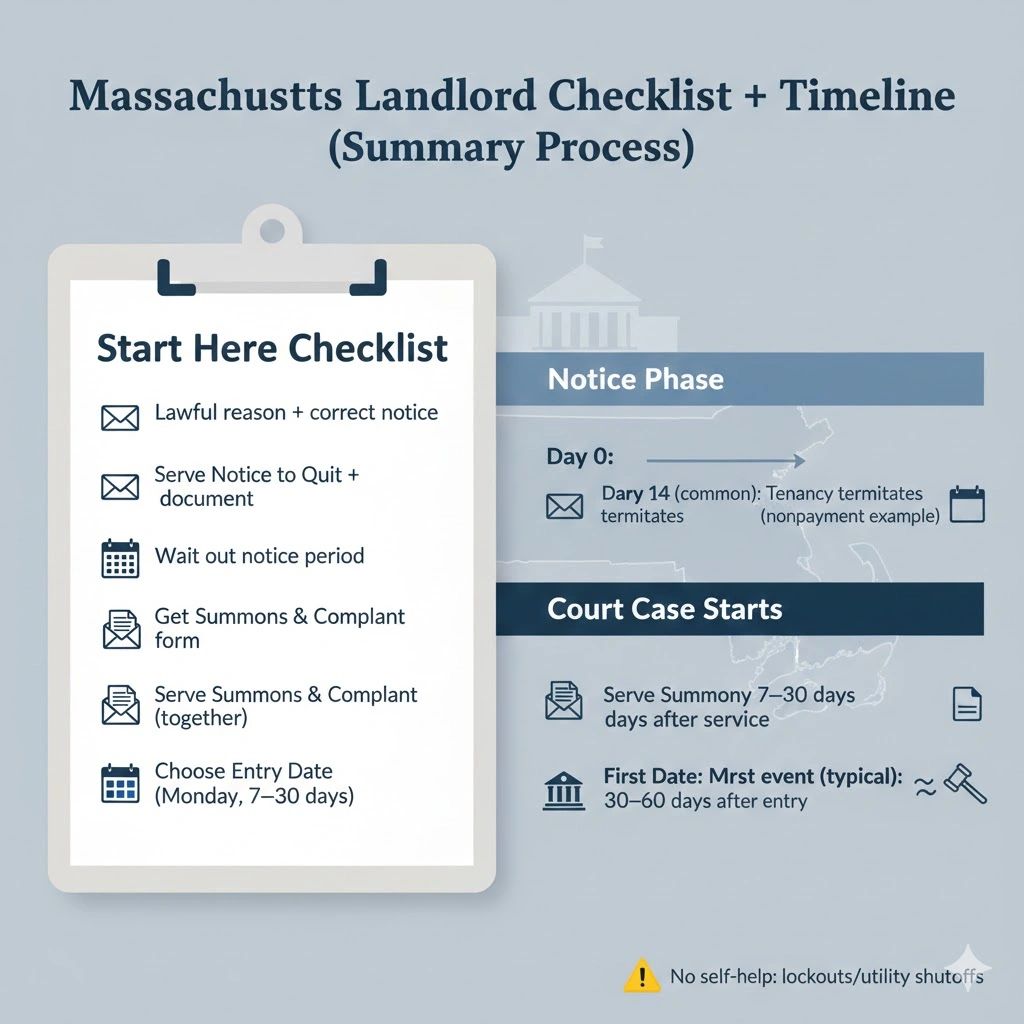
Landlord Checklist + Timeline (Summary Process)
Evictions in Massachusetts are a court process called summary process. If you try to “DIY” it with threats, utility shutoffs, or lock changes, you’re not starting an eviction. You’re starting a lawsuit against yourself.
This post is a practical, landlord-friendly checklist and a timeline so you can start correctly and avoid the most common faceplants.
Not legal advice. If your case has rent subsidy, domestic violence protections, retaliation claims, serious habitability issues, or a tenant who’s already lawyered up, talk to a Massachusetts landlord-tenant attorney before you light the fuse.
The “Start Here” Checklist
1) Confirm you have a lawful reason and the right notice
Your first real step is almost always a Notice to Quit that properly terminates the tenancy.
- Nonpayment is commonly a 14-day notice to quit (leases can change details, and there are exceptions).
- For other reasons (end of tenancy, lease violations, no-fault termination), the notice period and wording can vary a lot.
Reality check: the tenant does not have to move out just because they got a Notice to Quit. The notice ends the tenancy, but court is what can remove them.
Your homework before you serve notice:
- Pull the lease, rent ledger, and any written notices already sent.
- Make sure the notice date and termination date are correct for the tenancy type.
- Decide whether you’re seeking possession only or possession + money judgment (this affects paperwork and proof).
2) Serve the Notice to Quit and document it like you mean it
Treat service like evidence, because that’s what it becomes.
- Use a sheriff/constable/process server if you want clean documentation and fewer “I never got it” arguments later.
- Keep: a copy of the notice, proof of service, photos (if posted), and a service log.
3) Wait out the notice period (no shortcuts)
After the notice period ends (and the tenancy is terminated), then you can move to the court paperwork stage.
4) Get the Summary Process Summons and Complaint (Housing Court eSummons)
In Housing Court, landlords can purchase a Summary Process eSummons online through GovHub. Massachusetts also lists a required summons and Summons and Complaint form as separate line items at $5 each (plus other filing fees depending on court).
Practical tip: buy the form first, then sit down and fill it out carefully with your documents in front of you. Sloppy forms cause delays.
5) Have the Summons and Complaint served (together)
In Massachusetts, the summons and a copy of the complaint are served together. And per the eviction timeline guidance, you serve the summons and complaint only after tenancy is terminated.
6) Pick the Entry Date (it matters, and it’s not “whenever”)
This is where landlords mess up constantly.
Massachusetts eviction timeline guidance says:
- Entry Date must be a Monday
- It must be at least 7 days, but no more than 30 days, after service of the summons and complaint
So you can’t serve today and file tomorrow because you’re annoyed. The calendar rules run the show.
A Simple Massachusetts Eviction Timeline (Typical Flow)
Think of it in phases:
Phase A: Notice Phase
Day 0 – Serve the Notice to Quit Day 14 (common for nonpayment) – Tenancy terminates unless revived by payment (situational)
Phase B: Court Case Starts (Summary Process)
After tenancy terminates – Serve the Summons and Complaint 7–30 days after service (on a Monday) – Entry Date (you “enter” the case with the court) About 7 days from Entry Date – Court sends notice of first court event 3 business days before first court event – Tenant’s answer / jury demand / discovery due Often 30–60 days after Entry Date – First-tier event / mediation (Housing Court)
That’s the “start an eviction” portion in real-world timing: notice, service, entry date, first event.
Landlord Document Pack (Have These Ready Before You File)
If you want speed, don’t show up with vibes and a screenshot.
- Lease (and any amendments)
- Rent ledger (clean, readable, totals match)
- Notice to Quit + proof of service
- Summons & Complaint copy served + proof of service
- Any written cure offers, payment agreements, bounced checks, or relevant communications
- Photos/inspection notes if the case is based on damage/violations (use cautiously and truthfully)
Mistakes That Slow You Down (or Blow You Up)
- Bad notice (wrong dates, wrong tenancy type, wrong wording)
- Rushing entry date (not Monday, not within the 7–30 day window)
- Improper service or weak documentation
- Self-help eviction (lockouts, utilities, intimidation): courts hate it, and tenants’ attorneys love it