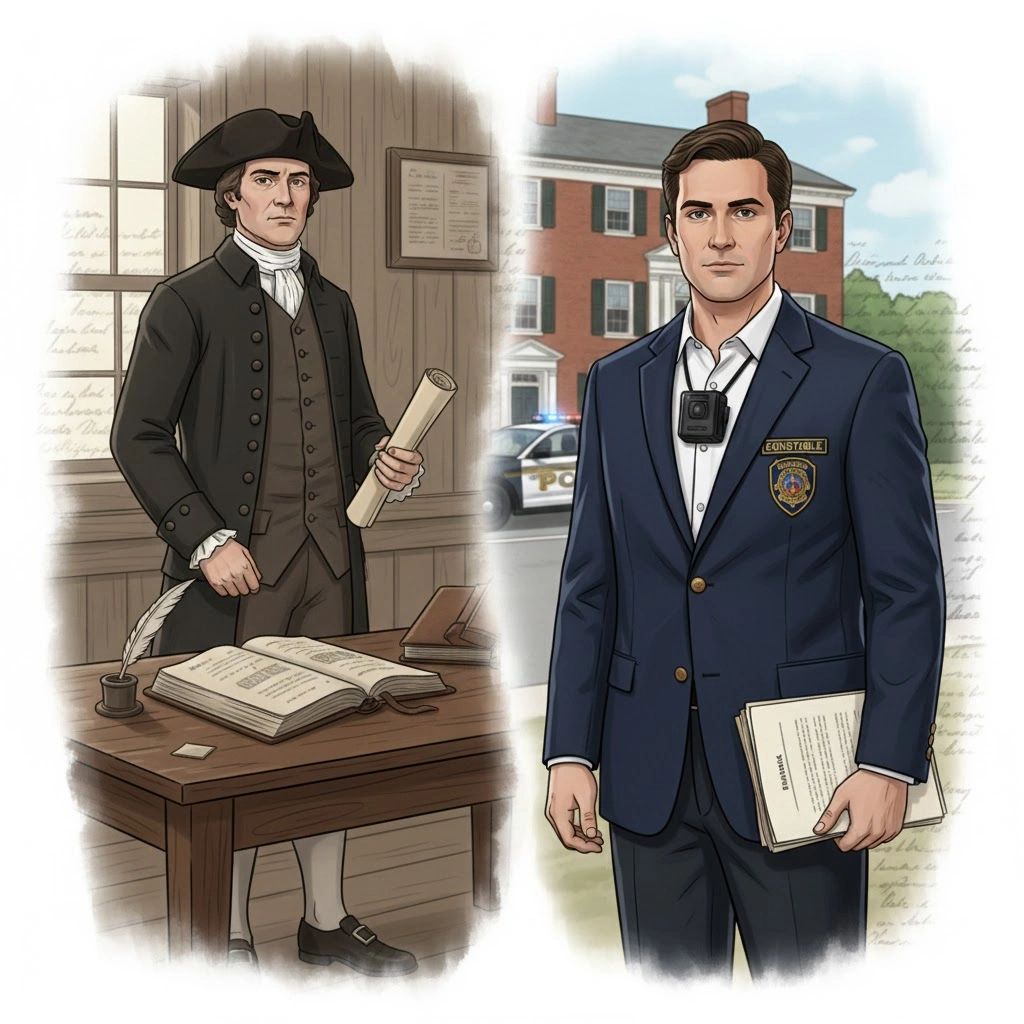
If you only know constables as “the people who serve papers,” you are missing about 900 years of job description.
In Massachusetts, the constable sits in a strange spot: ancient office, modern expectations, and now a world where POST certification and police reform are shaping what “peace officer” means. This post walks through where constables came from, how police spun off from them, and what the newer POST framework means for the work we do today.
Where it started: horses, kings, and “the peace”
The job starts way before Massachusetts.
The word “constable” traces back to comes stabuli in Latin, basically “count of the stable,” a senior officer responsible for the cavalry. Over time, especially in England, that military role changed into a civil one. The constable became a royal officer in the community, responsible for keeping what was called the “King’s peace.”
Under English common law, the constable was:
- A “peace officer” or “conservator of the peace”
- Expected to protect the tranquility of the community
- Armed with broad powers to intervene when that peace was threatened
This included quelling disturbances, arresting offenders without a warrant in many situations, and supervising the local night watch. The constable was not a faceless uniform; he was a known figure in the parish, someone everyone recognized and was legally bound to assist.
So long before there were police departments, there were constables doing the actual ground-level work of keeping order.
Crossing the Atlantic: constables in colonial Massachusetts
When English law came to Massachusetts, the office of constable came with it.
In the early towns, the constable was one of the first local offices created. The job looked something like this:
- Serve writs and court papers
- Collect rates and fines
- Enforce local by-laws and orders
- Respond to breaches of the peace
Constables were municipal officers and a critical part of how order was maintained in a new and growing colony. There was no “Boston Police Department.” There was the constable, the selectmen, and a toolbox full of common-law authority.
As towns grew and Boston turned into a real city, that model started to show its limits. One constable per town, working part-time, could not keep up with urban density, port traffic, and rising crime.
Watch and ward: the first step toward modern policing
The first “upgrade” to the constable system was the watch.
Colonial and early state laws allowed or required towns to keep a night watch and a day ward. The idea was simple:
- At night, watchmen patrolled the streets to watch for fire, disorder, and crime.
- During the day, ward officers helped keep public order.
- Constables were in charge of the watch.
Constables supervised the watchmen, questioned people out at night, detained suspicious individuals until morning, and reported conditions in town. Over time, the watch shifted from unpaid citizen duty to something more professional and more regularly paid.
This was the bridge between the one-off, part-time common-law constable and the idea of a staffed, organized, round-the-clock public safety system.
The birth of “police” from constable powers
The word “police” eventually shows up in Massachusetts law in the early 1800s, especially when Boston became a city.
Key moves in that transition:
- Administration of “the police” was shifted from town selectmen to a mayor and aldermen model.
- The legislature authorized the appointment of “police officers” with some or all of the powers of constables.
- Later laws allowed the creation of a unified police department, with a chief and rank structure, combining the watch and the police.
Critically, the state did not invent a brand new kind of authority out of thin air. Instead, it essentially said:
“We are taking the powers and duties that constables already had as conservators of the peace, and we are assigning them to a specialized, full-time police force.”
That is why, even today, Massachusetts law says police officers have the powers of constables, with one important exception: serving and executing civil process remains a constable and sheriff function. Police inherited the peacekeeping side, not the process-serving side.
Constables and civil process: what stayed with us
As police departments grew into their own thing, constables kept a different piece of the pie: civil process.
Modern Massachusetts constables:
- Are municipal officers, elected or appointed in specific cities or towns.
- Must be bonded for the service of civil process.
- Can serve a wide range of documents: summonses, complaints, summary process, executions, small claims, notices, and many others, subject to certain statutory limits and ad damnum caps.
- Often operate as independent contractors, rather than employees of a police department or county agency.
Deputy sheriffs handle similar work at the county level, often through larger for-profit entities. Constables tend to be more localized and leaner, which is why they can sometimes be more cost-effective for clients depending on distance and type of service.
In short: police handle criminal enforcement and patrol. Constables and sheriffs handle civil process and execution of certain court orders.
Peace officer in a modern world: Hartley v. Granville
The Supreme Judicial Court has confirmed the peacekeeping side of the constable’s role.
In Hartley v. Granville (1913), the court described a constable’s general duty as being:
- Vigilant to preserve the peace
- Working to prevent the commission of crime
- Arresting offenders who can lawfully be arrested without a warrant
- Obtaining warrants where necessary
That decision matters because it recognizes that a constable is more than a walking envelope. The office still carries peace officer responsibilities, especially within the town of appointment.
At the same time, Hartley draws an important line between:
- What a constable is already required to do as part of the office, and
- Extra services that are beyond the usual duty and can be billed separately.
For a modern constable business, that distinction is exactly where “standard fee” versus “special investigative work” gets drawn.
Then came POST: new oversight for modern police
Fast forward to the last few years.
In response to national and local concerns about policing, Massachusetts created the Peace Officer Standards and Training (POST) Commission. POST is responsible for:
- Certifying law enforcement officers
- Setting training and conduct standards
- Investigating misconduct
- Suspending or decertifying officers who commit serious violations
If you carry a badge and exercise state-sanctioned police authority in Massachusetts, you are increasingly expected to be POST certified, and to live under that oversight.
POST is focused primarily on police and similar roles, but the logic behind it is not limited to one patch or one shoulder emblem. The logic is:
“If you have the power to put your hands on people, use force, and take away liberty, the public gets a say in your training and accountability.”
Where constables sit in the POST era
Constables are not traditional municipal police officers. We are not hired into police departments, we do not fall under police chiefs in the same way, and our primary function is civil process.
That said, the world we operate in has changed:
- Evictions, capias work, and emotionally charged service encounters can look and feel a lot like police activity to the public.
- Courts and regulators are paying more attention to who is exercising coercive authority, how they were trained, and what standards they are held to.
The direction of travel is obvious: more training, more structure, more accountability, even for roles that historically sat a bit outside the police box.
For serious constable offices, the smart move is to stay ahead of that curve:
- Clear policies on what we can and cannot do
- Strong documentation and body worn camera usage
- Formal training, testing, and ongoing education, even where the statute does not force it yet
That is exactly why building a serious SOP library and training program matters. It is not just paperwork. It is how a centuries-old office survives and stays credible in a POST world.
Why this history actually matters to you
If you are a landlord, attorney, or property manager, this is not just trivia.
Here is what this history means in practice:
- Constables are not “fake cops.” We are part of a long legal tradition with clearly defined duties, powers, and limits.
- We are not sheriffs either. Our jurisdiction, bonding, and process authority are structured differently, and in many cases we can move faster and closer to the ground in our own towns.
- Police exist because constables once did the entire job. Many of the powers police have today came from constable authority, but police do not handle civil process. That stayed with us.
- In a POST world, professionalism is non-negotiable. The days of “I’ve got a badge and a printer, so I’m a constable” are over. Documentation, training, cameras, and policy are the new baseline.
At South County Constable Office, we take that seriously. We stand on the history, but we work like a modern professional service: policy-driven, transparent, and fully focused on doing the job by the book.
If you want help navigating a case that needs service, an eviction, or specialized process work, that is exactly what this mix of history and modern structure is built for.