
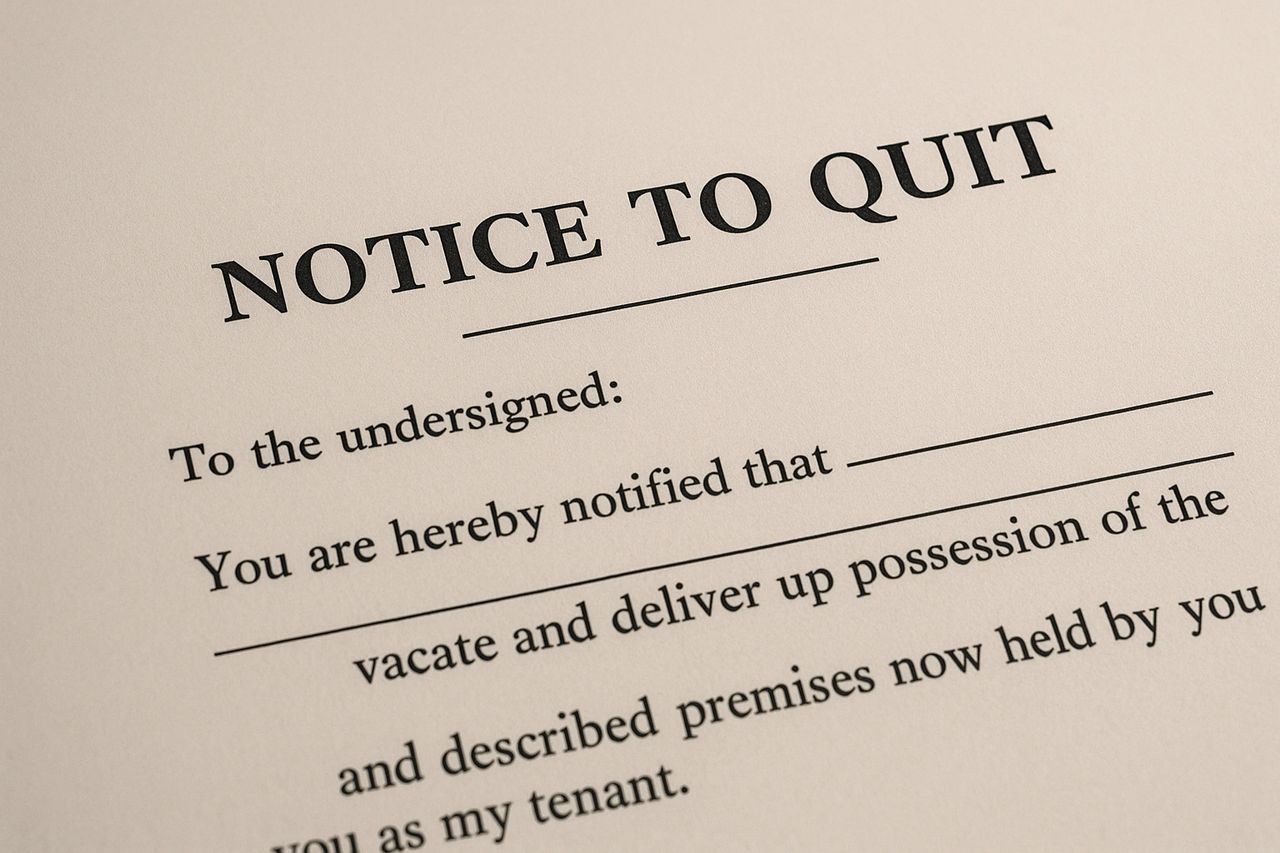
If you own rental property in Massachusetts, the Notice to Quit feels like the starting gun. You slap a 14-day nonpayment notice on the door, maybe mail a copy, and assume the clock is ticking toward lock change day.
This is exactly where a lot of landlords start losing weeks or months.
Massachusetts treats Notices to Quit as technical legal documents, not casual “pay or leave” notes. When you get them wrong, judges don’t “fix” them for you. They dismiss the case and you start over, with more unpaid rent piling up.
Let’s walk through the big mistakes landlords make with Notices to Quit and what you should be doing instead.
Mistake #1: Thinking a Notice to Quit is an eviction
A Notice to Quit is not an eviction order. At all.
Massachusetts courts and tenant guides are crystal clear:
- A Notice to Quit is just the first step a landlord must take to start the eviction process.
- It does not mean the tenant has to leave by that date.
- Only a court judgment and execution can legally force a tenant out.
Why this matters:
- If you send a Notice to Quit and then tell the tenant “you’re out on the 15th,” you’re wrong on the law and you’re handing them a story the judge is not going to like.
- If you change the locks or shut off utilities after the notice expires, that can be an illegal lockout, even if your notice was perfect.
Treat the Notice to Quit as what it is: a required legal prerequisite to a Summary Process case, not a magic eviction wand.
Mistake #2: Using a one-size-fits-all notice for every situation
Massachusetts law doesn’t give you one universal notice. It gives you different rules depending on the reason for termination and the type of tenancy.
Key distinctions:
- Nonpayment of rent (tenant at will): Usually a 14-Day Notice to Quit under M.G.L. c. 186 § 12, with cure rights in many first-time cases.
- Ending a tenancy at will / “no-fault”: Requires a written notice equal to one full rental period, but at least 30 days.
- “Cause” cases (violations, nuisance, certain illegal activity): Often still require a full rental period notice for tenants at will. Shorter 7-day notices usually come from specific lease language or specialized situations, not the default statute.
On top of that, the notice has to be:
- Timely,
- Definite, and
- Unequivocal (no mixed messages about whether you’re really ending the tenancy).
If you grab a random generic form off the internet and slap it on every problem, you’re gambling with your case.
Mistake #3: Ignoring the mandatory “Accompanying Form” in nonpayment cases
This one is a quiet killer.
Since 2023, every residential Notice to Quit for nonpayment of rent in Massachusetts must be served with a specific state form: the “Form to Accompany Residential Notice to Quit.”
By law (M.G.L. c. 186 § 31), that form has to:
- Document any repayment agreements between landlord and tenant.
- Explain rental assistance programs, including RAFT.
- Point to trial court rules and standing orders for Summary Process.
- Flag any federal or state restrictions on residential evictions.
The courts even created an Affidavit of Compliance where you swear under oath that you gave the tenant the required form with the notice.
On top of that, current RAFT rules say:
- RAFT can provide up to $7,000 in assistance in any rolling 12-month period to help keep a tenant housed or move them to stable housing.
Why this matters for landlords:
If you serve a 14-Day Notice to Quit for nonpayment without this accompanying form, the court can refuse to let you even start the case.
That means you’ve just burned a notice period for no gain and delayed yourself by a month or more.
Mistake #4: Treating “cause” cases like they get automatic 7-day notices
A lot of landlords assume:
“If it’s bad behavior, I can use a short 7-day notice.”
Not in most Massachusetts tenancies at will.
The default rule in M.G.L. c. 186 § 12 is that to terminate a tenancy at will, you must give a written notice equal to one full rental period, with a minimum of 30 days.
Shorter notices (7 or 14 days) typically come from:
- A written lease that clearly allows a shorter notice for particular violations, or
- Specific types of serious nuisance or illegal conduct where courts will enforce a shorter period under the facts and lease.
If you fire off a 7-day “cause” notice at a month-to-month tenant without solid legal backing, you’re inviting the court to find the notice defective and make you start over.
Mistake #5: Sloppy or vague termination dates
Massachusetts courts expect Notices to Quit to be precise about termination:
- For tenants at will, the notice generally has to end the tenancy on a day when rent is payable and allow a full rental period or 30 days, whichever is longer.
- The notice must be unequivocal, so that a reasonable person can tell exactly when the tenancy ends and why.
Examples of things that get landlords in trouble:
- Ending the tenancy on some random mid-month date that doesn’t line up with the rent period.
- Using fuzzy language like “you are hereby asked to vacate around the 15th.”
- Mixing threats and offers in the same notice so it’s not clear whether you actually terminated the tenancy.
Judges don’t like guesswork on termination dates. If the notice is unclear or doesn’t line up with the law, your Summary Process case is built on sand.
Mistake #6: Treating service like a formality
In theory, Massachusetts law doesn’t say “you must use a constable” to serve a Notice to Quit. In practice, how you serve it matters a lot once you’re in front of a judge.
Courts and legal aid resources repeatedly stress that the landlord must be able to show the tenant received proper notice before an eviction can move forward.
Common problems:
- Only emailing the notice with no proof it was actually received.
- Slipping it under the door with no witness, photo, or affidavit.
- Forgetting to keep a copy of what you served and when.
What judges care about:
- Can you prove what you served?
- Can you prove who you served and how?
- Can you prove when you served it and that the timing meets the statute?
This is why many landlords lean on experienced constables and deputy sheriffs for service. They provide a Return of Service that answers those questions cleanly.
Mistake #7: Treating the notice date as a lock-change deadline
Tenant-facing materials from the Commonwealth hammer this point:
“YOU DO NOT HAVE TO MOVE OUT BY THE DATE ON THE NOTICE TO QUIT.”
The date on the notice is the legal termination date, not the “you must be physically gone or I’ll change the locks” date.
The actual eviction path is:
- Proper Notice to Quit (with accompanying form in nonpayment cases).
- Proper service and filing of a Summary Process case.
- Judgment for possession in court.
- Issuance of an Execution for Possession.
- Service of a 48-hour notice by a sheriff or constable, then the physical move-out with movers.
If you treat the notice date as a hard move-out deadline, you’re almost guaranteed to say or do something that looks like an illegal lockout when the tenant doesn’t instantly vanish.
Mistake #8: Assuming the court will “fix” a bad notice
Here’s the cold reality:
If the Notice to Quit is defective, the usual result is not a slap on the wrist. It’s a dismissal, and you start the whole process from scratch.
Common reasons judges toss cases:
- Wrong notice period for the type of case.
- Wrong or unclear termination date.
- No proof that the required Accompanying Form was served in nonpayment cases.
- Notice that doesn’t clearly state why the tenancy is being terminated.
Every time that happens, you lose:
- Another notice period,
- Another filing fee,
- Another month (or more) of rent.
A better way to think about Notices to Quit
If you’re a Massachusetts landlord, here’s a more accurate mindset:
- The Notice to Quit is the foundation of your eviction case. If it’s cracked, the case collapses.
- Reason drives the form and timing. Nonpayment, cause, and no-fault terminations do not use identical notices or notice periods.
- Nonpayment = notice plus mandatory form. For residential nonpayment, the 14-Day Notice to Quit must be served with the state’s Accompanying Form, and you’ll be swearing to that later.
- Tenancies at will = rental period logic. For most cause and no-fault terminations, you’re looking at one full rental period, at least 30 days.
- Service and documentation matter as much as the wording. If you can’t prove what you served, when you served it, and how, you’re exposed.
Quick checklist: Before you serve your next Notice to Quit
Before you tape, mail, or serve anything, run through this:
- Have I picked the right notice for the reason (nonpayment, cause, no-fault)?
- Am I using the correct notice period under M.G.L. c. 186 and any lease terms?
- For nonpayment, am I including the Form to Accompany Residential Notice to Quit and planning to complete the Affidavit of Compliance later?
- Is the termination date clear, definite, and aligned with the rent period?
- Does the notice clearly state why I’m terminating the tenancy?
- Do I have a reliable way to prove service (constable/sheriff, or at least solid documentation)?
Get the notice right and you give your future Summary Process case a solid foundation. Get it wrong and you’re signing yourself up for extra months of aggravation and unpaid rent.