
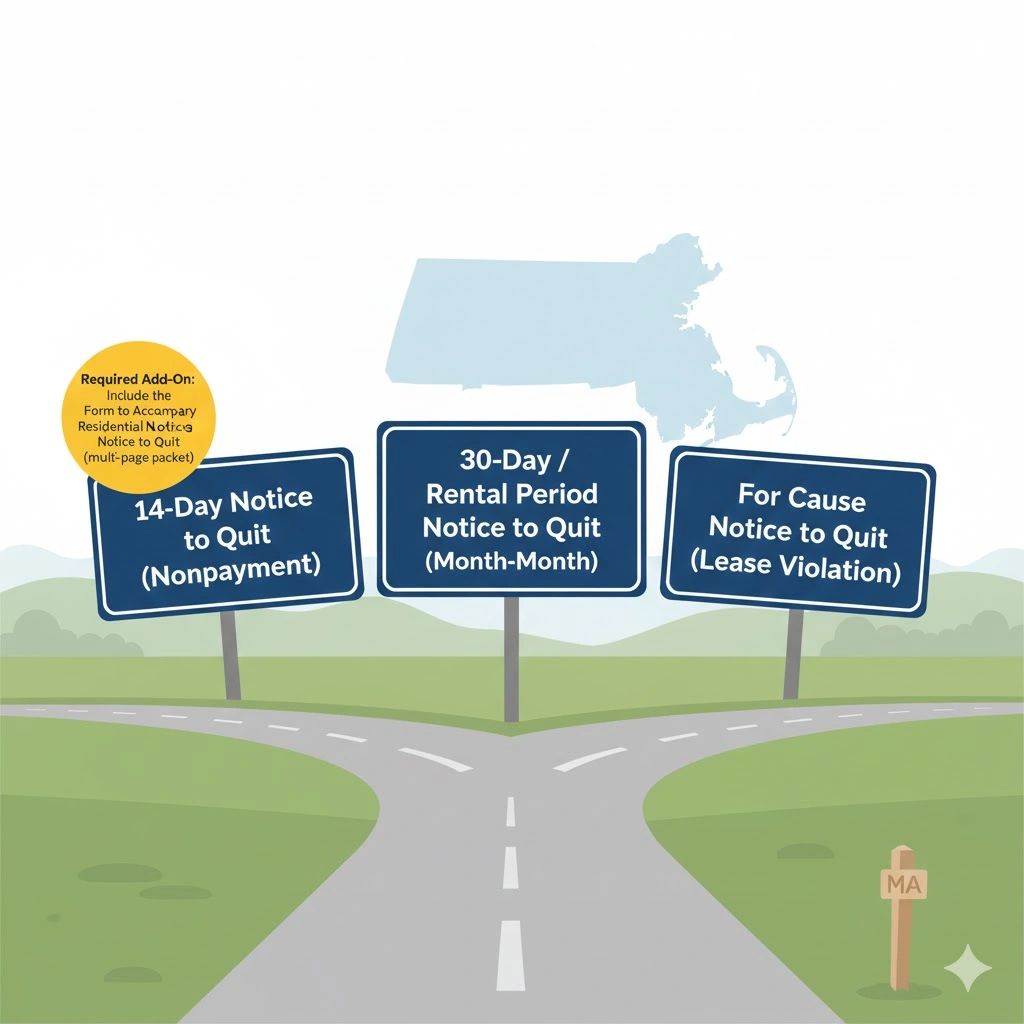
If Massachusetts eviction cases had a “most common unforced error,” it’s this: serving the wrong Notice to Quit, or serving the right one without the required attachments, and then acting shocked when the court hits you with the procedural equivalent of “Nope, do it again.”
A Notice to Quit is usually the first formal step in a Massachusetts eviction (summary process). It’s not a magic wand. It’s the document that terminates the tenancy (or demands compliance) so you can file in court if the tenant does not leave.
Not legal advice. This is practical information. If your case involves rent subsidy, domestic violence protections, retaliation claims, serious habitability issues, or the tenant has counsel, talk to a Massachusetts landlord-tenant attorney before you light the fuse.
The 10-second cheat sheet
- 14-Day Notice to Quit: Use for nonpayment of rent. (Baseline rule is 14 days.)
- 30-Day (or one full rental period) Notice to Quit: Use to end a tenancy at will (month-to-month) when you are not alleging a violation.
- “For Cause” Notice to Quit: Use for lease violations or misconduct (other than simple nonpayment). The timing and wording often depend on the lease terms and the specific issue.
And here’s the big update landlords keep missing:
If you serve a residential 14-day nonpayment Notice to Quit, you must include the Commonwealth’s “Form to Accompany Residential Notice to Quit” with the notice. It’s a multi-page packet (often about 11 pages, depending on the current version).
Skip the form, and you are building your eviction case on a cracked foundation.
Step 1: Identify the tenancy and the reason
Before you pick a notice, get these two facts straight:
- Tenancy type
- Fixed-term lease (for years)
- Tenancy at will (month-to-month)
- Reason
- Nonpayment
- End of tenancy (no-fault termination of month-to-month)
- Lease violation or misconduct (“for cause”)
Pick the notice based on what you can prove and what the law and lease allow, not based on what feels satisfying.
The 14-Day Notice to Quit (Nonpayment)
When you use it
Use a 14-Day Notice to Quit when the tenant has not paid rent. Massachusetts law recognizes fourteen days’ written notice to quit as sufficient in this nonpayment context (with important details and exceptions depending on the situation).
The non-negotiable add-on: the required accompanying form
If this is a residential nonpayment Notice to Quit, Massachusetts requires the landlord to deliver the state “Form to Accompany Residential Notice to Quit” along with the notice. This requirement is tied into the nonpayment notice process and is addressed in M.G.L. c. 186 § 31, with the official form published by the Commonwealth.
What this means in real life:
- Your service packet for a residential nonpayment case is not “just the notice.”
- It is the Notice to Quit + the accompanying form (and any other required items based on the tenancy and your facts).
What it does (and does not do)
- Does: terminates the tenancy for nonpayment and tees up the next step if the tenant does not pay or leave.
- Does not: remove the tenant. If they stay, you still need to file summary process and get a judgment, then an execution.
Common landlord faceplants
- Wrong rent amount (bad math, mixing rent and other charges incorrectly)
- Bad dates
- Sloppy service (no proof, unclear who was served, improper method)
- The big one lately: forgetting the accompanying form
The 30-Day (or One Full Rental Period) Notice to Quit (Month-to-Month, No-Fault)
When you use it
Use this when the tenant is tenancy at will (typically month-to-month) and you want to end the tenancy without alleging a lease violation.
Why it’s not always exactly “30 days”
People call it a “30-day notice,” but timing commonly needs to line up with a full rental period. If your termination date is off-cycle, you can end up delaying yourself.
Common mistakes
- Using this for nonpayment when you should be on the 14-day nonpayment track
- Picking the wrong termination date
- Trying to terminate mid-lease on a fixed term (not how this works in most cases)
Think of this notice as: “I’m ending a month-to-month arrangement cleanly.”
“For Cause” Notices (Lease Violations and Misconduct)
What “for cause” means
“For cause” means you are claiming the tenant violated the lease or engaged in misconduct that justifies termination. Examples landlords often cite:
- Unauthorized occupants
- Unauthorized pets
- Repeated noise or nuisance behavior
- Property damage
- Other material lease breaches
Timing varies
Here’s the annoying truth: there is no single universal “for cause = X days” rule you can safely slap onto every situation. The required timing and cure language often depend on:
- The lease wording (notice and cure clauses)
- The type of violation
- Whether the tenancy is fixed term or at will
Common mistakes
- Vague allegations (“tenant is a problem”) instead of specific, documentable conduct
- Skipping a required “cure” opportunity if your lease calls for it
- Trying to use “for cause” as a shortcut for speed
If you are going to allege cause, be precise and be ready to prove it.
Choosing the right notice: quick scenarios
- Tenant did not pay rent: 14-Day Notice to Quit + required accompanying form (residential).
- Month-to-month, you just want possession back (no-fault): 30-Day / one full rental period Notice to Quit.
- Lease violation or misconduct: For cause notice drafted to match the lease requirements and the facts.
Reality check: the notice is step one, not the finish line
A Notice to Quit is not an eviction. Even the required state form says that plainly. Only a court order can force a tenant out.
If you try to “DIY” it with lock changes, utility shutoffs, threats, or property removal, you are not speeding up an eviction. You are creating liability.
Service matters more than people think
Courts do not care that you “meant well.” They care what was served, when, how, and whether you can prove it.
A clean service packet and a clean timeline save you money and weeks of delay.