
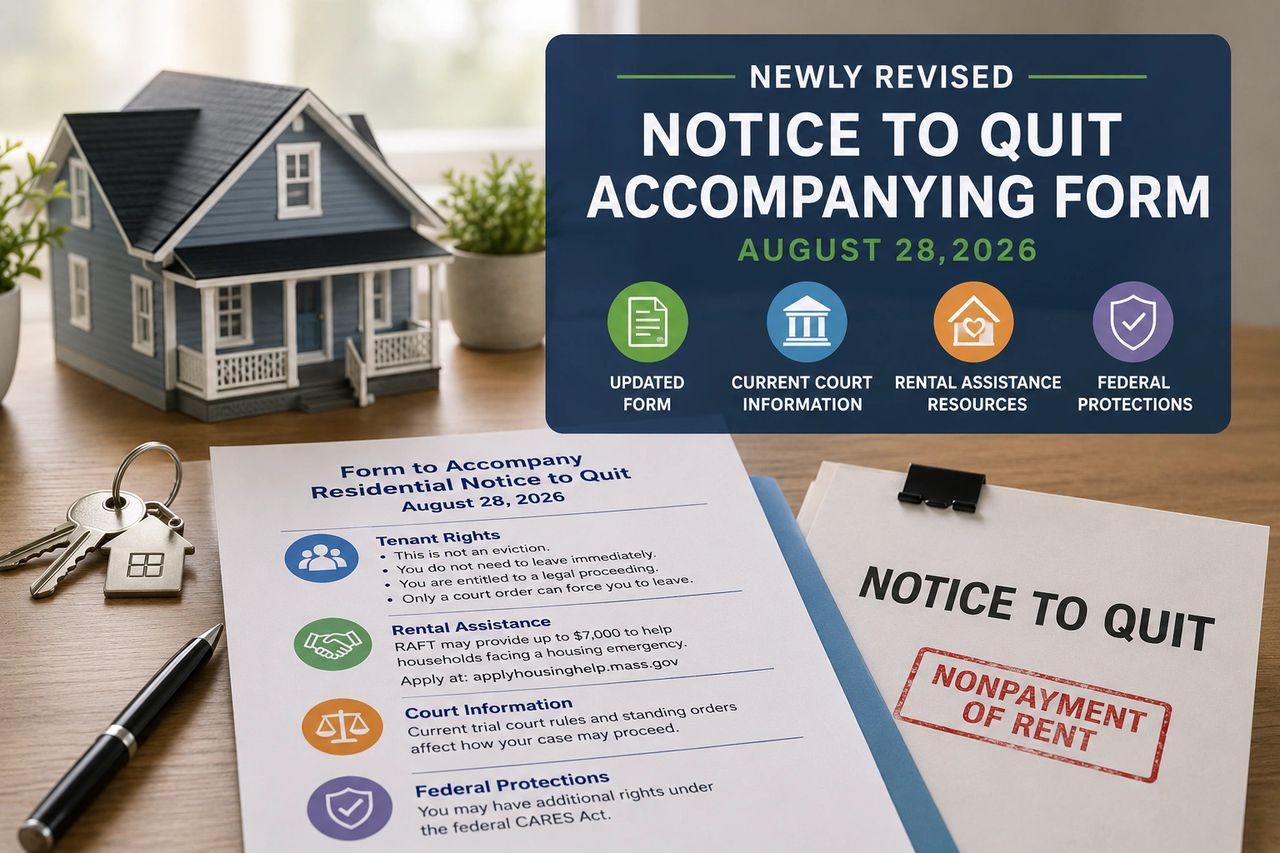
Landlords and Property Managers: Make Sure You Are Using the August 28, 2026 Version
If you handle residential nonpayment Notices to Quit in Massachusetts, check the form you are using before sending your next notice out for service.
The Massachusetts Form to Accompany Residential Notice to Quit has been revised again, with the current form dated August 28, 2026.
This comes shortly after a previous revision in July 2026. That means landlords, property managers, attorneys, and anyone preparing nonpayment Notices to Quit should make sure an older version has not remained in their forms folder, case-management system, or saved document templates.
What Is This Form?
Under M.G.L. c. 186, §31, a landlord giving a residential tenant a Notice to Quit for nonpayment of rent must accompany that notice with the required state form.
The form itself now states:
“Form to Accompany Residential Notice to Quit – August 28, 2026.”
This is not the Notice to Quit itself. It is a separate required document that accompanies a residential nonpayment Notice to Quit.
That distinction matters.
What Does the Form Tell the Tenant?
The form prominently tells tenants that a Notice to Quit is not an eviction and that receiving one does not require the tenant to immediately leave the property.
It also advises tenants that they are entitled to a legal proceeding in which they can defend against the eviction and that only a court order can ultimately force them to leave the unit.
The form also addresses whether the landlord and tenant have an existing written or verbal agreement concerning repayment of overdue rent. If there is an existing written agreement, the form states that a copy must be attached.
Rental Assistance Information Has Been Updated
The August form contains information concerning the Residential Assistance for Families in Transition program, commonly known as RAFT.
The current form explains that RAFT may provide eligible households with up to $7,000 per household to help preserve existing housing or move to new housing.
It also directs tenants to the Housing Help Hub and provides information about 211 and local Housing Consumer Education Centers.
For landlords, the practical point is simple: do not recreate this information yourself or rely on an old copy of the accompanying form. Use the current state-issued version.
The Form Also Contains Current Court Information
The new form includes information about Massachusetts Trial Court rules and standing orders affecting summary process cases.
It identifies current orders affecting Housing Court, District Court, and Boston Municipal Court summary process proceedings.
This is one reason these forms can change even when the underlying requirement to provide the accompanying form has not changed.
Administrative procedures, assistance programs, court orders, and other information contained in the form can be updated.
Federal CARES Act Information Remains Included
The August form also continues to warn tenants that additional federal protections may apply.
It specifically addresses properties that may qualify as a federally covered dwelling under the CARES Act and advises that a landlord may be required to provide at least 30 days’ written notice before filing an eviction action.
This is an important issue for landlords because compliance with Massachusetts Notice to Quit requirements does not necessarily resolve separate federal requirements.
Properties with federally backed mortgages, federal housing involvement, HUD tenant-based vouchers, or other federal connections may require additional analysis.
If you are unsure whether the CARES Act applies to a particular property, that is a good question to raise with qualified housing counsel before beginning the eviction process.
The Form Is Multilingual
The current document is 12 pages.
The first two pages contain the English version and information concerning court rules and federal protections. The remaining pages provide the required information in additional languages, including Spanish, Vietnamese, Portuguese, Haitian Creole, and Chinese.
Do not assume that only the English pages need to accompany the notice.
Use the complete current form as issued.
Why Another Revision Matters
It is easy to dismiss a form revision as administrative housekeeping.
That can be a mistake.
Massachusetts summary process is highly procedural. A landlord can have a legitimate claim for unpaid rent and still create unnecessary problems by using outdated documents or failing to provide something that the law requires to accompany a Notice to Quit.
The fact that the form was revised recently and has now been revised again makes this particularly important.
A landlord or property manager who downloaded the form in July 2026 may reasonably believe they already have the current version.
They may not.
The current form is dated:
August 28, 2026
Check the date.
A Simple Practice That Can Prevent Problems
Landlords and property managers should avoid keeping uncontrolled copies of frequently updated Massachusetts eviction forms scattered across computers, email folders, and old case files.
Before preparing a new residential nonpayment Notice to Quit:
1. Check the accompanying form’s revision date.
2. Make sure you are using the current state-issued form.
3. Complete the landlord, tenant, property, and repayment-agreement information accurately.
4. Attach any existing written repayment agreement when the form requires it.
5. Keep the complete multilingual form together.
6. Have the Notice to Quit and required accompanying documents served together.
And if there is any uncertainty about what documents are legally required for a particular tenancy, property, subsidy, or eviction, consult a Massachusetts attorney experienced in housing law before proceeding.
For Attorneys and Property Managers Sending Notices Out for Service
There is another practical issue worth mentioning.
When sending a residential nonpayment Notice to Quit to a constable or process server, provide the complete service package.
Do not assume the person serving the documents will know whether an accompanying form sitting in your office is the version you intended to use.
The attorney, landlord, or property manager preparing the notice should make sure the package is complete and current before sending it for service.
A process server can serve the documents provided. The underlying legal sufficiency of the notice package remains an issue that should be addressed by the party preparing the notice and, when appropriate, legal counsel.
The Bottom Line
Massachusetts has revised the Form to Accompany Residential Notice to Quit again.
The current version is dated August 28, 2026.
If you recently downloaded or saved a version from July, check it before using it again.
For residential nonpayment cases, the accompanying form is not an optional handout. It is part of the statutory Notice to Quit process.
Using the current form is a simple step.
Finding out later that an outdated form created an issue in an eviction case is considerably less simple.
Legal Disclaimer: This article is provided for general educational and informational purposes only. It is not legal advice. Massachusetts summary process and landlord-tenant law are technical and fact-specific. Landlords and property managers should consult with a qualified Massachusetts attorney experienced in housing law regarding the preparation of a Notice to Quit, the applicability of state or federal requirements, or any specific eviction matter.